
BOPP Thermal Lamination Film Compliance Guide: Certifications, Standards, and Regional Requirements
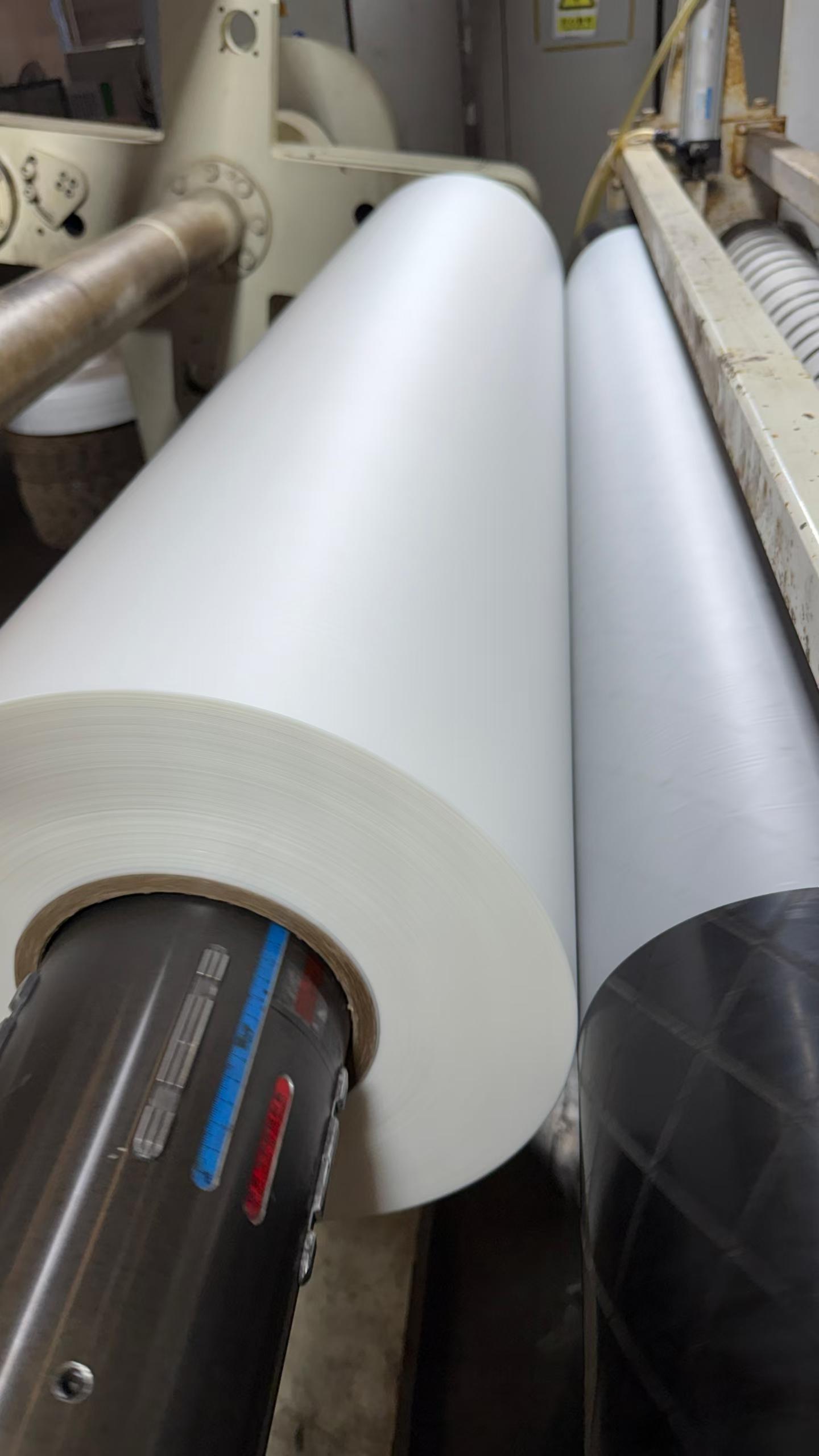
BOPP thermal lamination film compliance is not a single certificate. For a packaging or printing buyer, it is a chain of evidence that must connect the exact film grade, the lamination process, the destination market and the end use. A BRCGS certificate, an ISO 9001 certificate, an AEO customs credential and a REACH SVHC test report answer different questions. Treating them as interchangeable is one of the most common qualification errors.
This guide is written for buyers in the research and evaluation stages who are specifying BOPP thermal lamination film across regions. It explains the main certificate categories, how to read their scope, where regional requirements differ, and how to verify a supplier during qualification. It uses supplied evidence from SHKFILM (Shandong Shunkai Composite Material Co., Ltd.), including No-primer BOPP Base Film for BOPP Thermal Lamination Film (product 6544) supplied for over 10 years and more than 10,000 tons across Brazil, South Korea, India, Iran and Japan, and BOPP Thermal Lamination Film (product 6615) distributed in Brazil and Italy. Those supply facts show multi-region experience; they do not by themselves certify every product for every market.
Problem definition: why a certificate folder is not a compliance answer
The buyer’s real question is narrower than “is the supplier certified?” It is: which document covers this product, this production scope and this market, and what does it actually test or attest? A management-system certificate may cover a site’s quality process but not the migration performance of a finished laminate. A test report may cover a specialty anti-scratch film but not a standard gloss thermal film. A customs credential may speed border clearance but says nothing about food-contact suitability.
That distinction matters because BOPP thermal lamination film is sold in several product forms. SHKFILM’s supplied range includes BOPP Thermal Lamination Film (Gloss / Matte Thermal Lamination Film Series, product 6615), BOPP Specialty Lamination Films (Anti-Scratch Film Series / Soft Touch Film Series, product 6623), BOPP Matte Film for Wet Lamination (Matte Wet Lamination Film Series, product 6647), and No-primer BOPP Base Film for BOPP Thermal Lamination Film (No-Primer Base Film Series, product 6544). Each has a different role in the lamination chain. A compliance matrix that does not name the exact series and grade is incomplete.
Decision rule: before accepting any certificate, ask three questions: Does it name the product family or grade? Does its scope match the production or test activity? Is it valid for the destination market and end use under review?
Industry background: more documentation, more cross-border supply
The broader BOPP film market provides context for the documentation pressure. Grand View Research valued the global BOPP films market at USD 31.0 billion in 2025 and projected it to reach USD 49.8 billion by 2033; the same source put Asia Pacific’s revenue share at 32.2% in 2025. Future Market Insights forecast the global thermal lamination films market to reach USD 1,547.9 million by 2025, with BOPP-based films as the leading film type segment. These figures describe market scale, not compliance requirements, but they explain why buyers in Europe, North America and Asia are asking suppliers for more traceable evidence.
SHKFILM’s own profile illustrates the supply pattern behind those requests. The company was founded in August 2010, operates two BOPP film production lines imported from Brückner (Germany), and reports an annual capacity of 30,000 tons, a factory size of 146,667㎡, 235 employees and a 10-engineer R&D team. Its export ratio is about 70%, with main markets listed as India, Brazil, Iran and Korea. It supplies both converters with their own coating or lamination lines and distributors who resell finished film. That mix means a single buyer may need different evidence: a converter may focus on base-film consistency and coating compatibility, while a distributor may focus on finished-film test reports, customs documentation and private-label supply.
The no-primer base-film route is also relevant to environmental documentation. SHKFILM’s product description states that its no-primer BOPP base film eliminates primers and drying ovens and produces no ozone or VOC emissions. That is a product-design statement, not a substitute for a site’s environmental permit or a finished-film VOC test. Buyers should still ask for the specific ISO 14001 scope or test report that applies to the product and site under review.
Detailed solution: build a four-layer compliance evidence chain
The most practical way to evaluate BOPP thermal lamination film compliance is to separate documents into four layers. Each layer answers a different buyer question, and none should be used to fill a gap in another.
Layer 1: management-system certificates
Management-system certificates show that a site operates under a documented system. In the supplied evidence, SHKFILM holds ISO 9001:2015 certificate No. 57626Q00025R201, issued by Qingdao Wanhui Inspection and Certification Co., Ltd, covering the R&D and production of biaxially oriented polypropylene films and the processing of functional films. The same issuer certifies ISO 14001:2015 environmental management under No. 57626E00021R101 and ISO 45001:2018 occupational health and safety management under No. 57626S00018R101. The ISO 9001 and ISO 14001 certificates are listed with an expiry date of 8 February 2029; the ISO 45001 certificate is also listed with an expiry date of 8 February 2029.
These certificates support supplier qualification: they indicate that quality, environmental and safety processes are managed at the audited sites. They do not prove that a particular BOPP thermal lamination film grade meets a food-contact limit, a VOC threshold or a customer’s restricted-substance list. Keep them in the supplier-qualification layer, not the product-release layer.
Layer 2: customs and supply-chain credentials
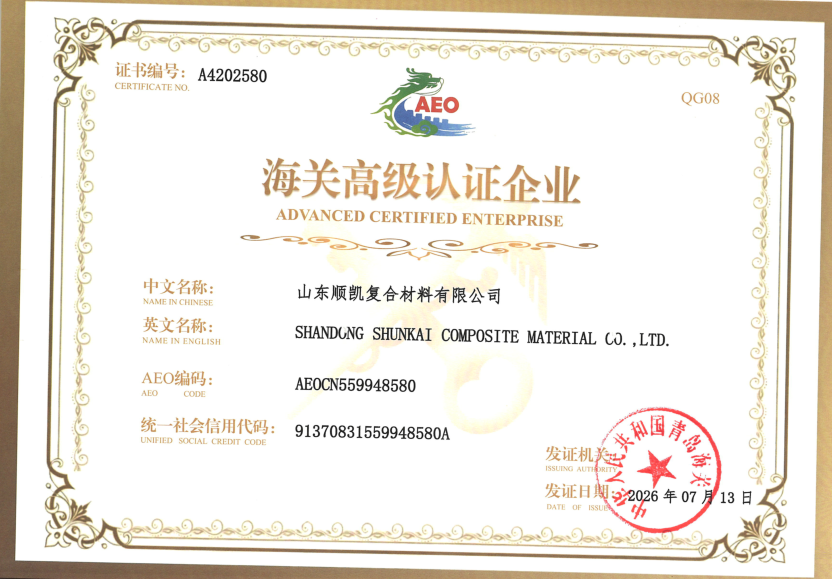
AEO status is a customs and supply-chain security credential. SHKFILM holds an Advanced Certified Enterprise (AEO) Certificate, certificate No. A4202580, issued by Qingdao Customs of the People’s Republic of China. The supplied scope covers all import and export activities of Shunkai for manufactured plastic films and laminating materials. The certificate is listed as valid to 1 December 2030 and is recognized through mutual recognition arrangements with the EU, North America, the UK, Singapore, South Korea, Japan and over 50 countries or regions.
For a buyer, AEO can be relevant to documentation speed, border predictability and supplier credibility in cross-border trade. It is not a product-compliance certificate. A supplier can hold AEO and still need a separate REACH, RoHS, halogen-free or food-contact document for the exact film grade.
Layer 3: retail and food-safety scheme certification
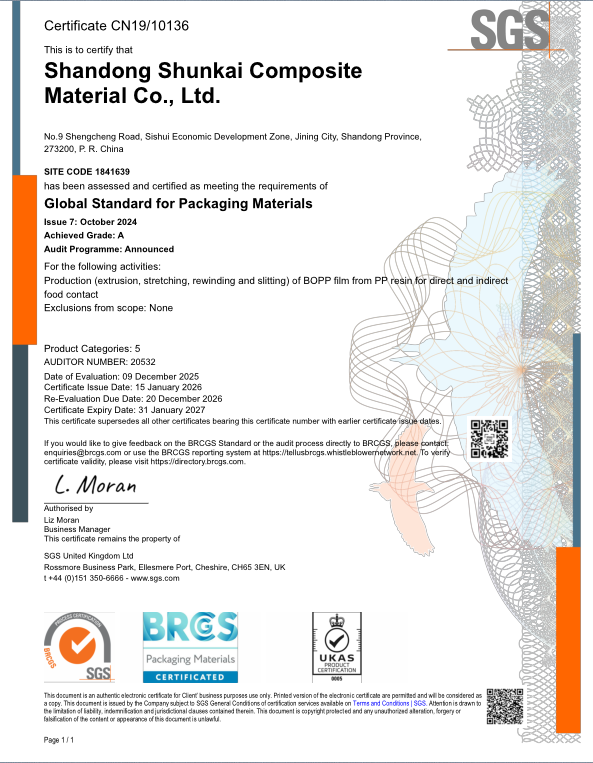
BRCGS is a GFSI-benchmarked scheme used in retail and food-service supply chains. The supplied evidence lists SHKFILM’s BRCGS Global Standard for Packaging Materials certificate No. CN19/10136, issued by SGS, under Issue 7 (October 2024). The scope is production (extrusion, stretching, rewinding and slitting) of BOPP film from PP resin for direct and indirect food contact. The certificate is listed with an issue date of 15 January 2026 and an expiry date of 31 January 2027. BRCGS certification is often requested for retail and food-service supply chains in the US and UK, and it is relevant where the packaging is intended for direct or indirect food contact.
The scope detail matters. The supplied BRCGS record is tied to BOPP film production for food contact and is listed in the related-product data for BOPP Matte Film for Wet Lamination (product 6647) and No-primer BOPP Base Film (product 6544). A buyer specifying a different grade, such as a gloss thermal film or a specialty anti-scratch film, should ask the supplier to confirm whether that grade falls within the certified production scope or whether a separate declaration applies. Do not assume that a BRCGS logo on a website covers every film in the catalogue.
Layer 4: product and material test reports
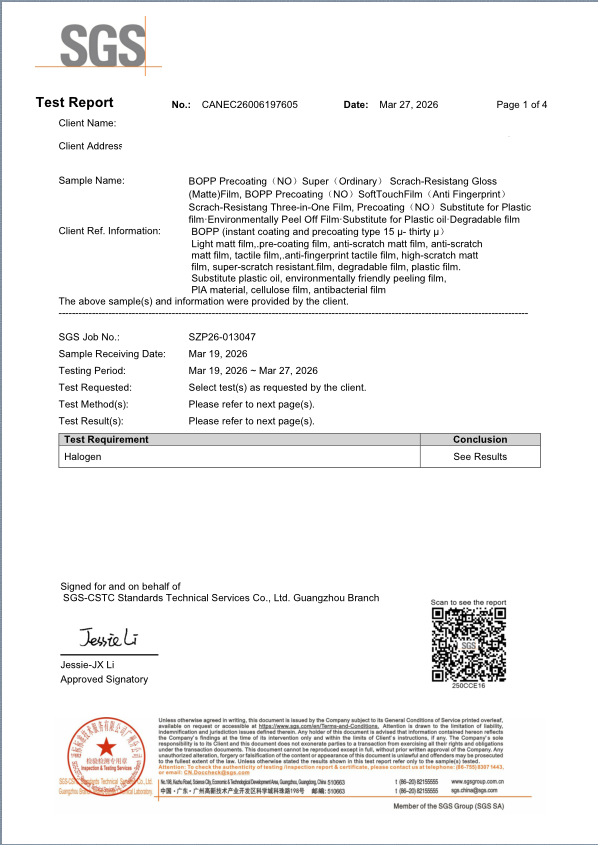
Product test reports are the most grade-specific layer. The supplied evidence includes several SGS reports for BOPP Specialty Lamination Films thermal type. REACH SVHC verification is reported under certificate No. CANEC26006197603 against Regulation (EC) No 1907/2006 and the Candidate List of 253 SVHCs. RoHS verification is reported under certificate No. CANEC26006197601 against Directive (EU) 2015/863 amending Annex II to Directive 2011/65/EU, tested via the IEC 62321 series. Halogen-free verification is reported under certificate No. CANEC26006197605 against EN 14582:2016. Two SGS VOC reports under GB 33372-2020 are listed: No. CANEC26006194201 for anti-scratch gloss and matt film, and No. CANEC26006194203 for the 3-in-1 anti-scratch, soft-touch and anti-fingerprint film.
These reports address different questions. REACH SVHC screening looks at substances on the candidate list. RoHS checks restricted substances under the EU directive. EN 14582:2016 is a halogen test method, not a general eco-label. GB 33372-2020 is a VOC-content standard used in the supplied reports for specialty films. A buyer should not accept a REACH report as proof of RoHS compliance, or a halogen-free report as proof of low VOC content. Each claim needs its own test scope and limit.
The same principle applies to product identity. The supplied REACH, RoHS, halogen-free and VOC reports are listed for BOPP Specialty Lamination Films thermal type, including anti-scratch, soft-touch and 3-in-1 products. They should not be silently extended to every BOPP thermal lamination film. If the buyer’s specification is for a standard gloss or matte thermal film, the supplier should provide the test package that names that grade, or state clearly which declarations apply by family and which are grade-specific.
Step-by-step breakdown: how to verify supplier compliance during qualification
The following workflow turns the four layers into a repeatable qualification process. It is written for a buyer evaluating a new supplier or re-evaluating an existing one for a new market or application.
- Write a compliance brief before requesting documents. Define the product family (for example, BOPP Thermal Lamination Film 6615 or BOPP Specialty Lamination Films 6623), the lamination process (thermal or wet), the substrate, the printing ink coverage, the destination market and the end use. State whether the pack is intended for direct food contact, indirect food contact or non-food use. This brief prevents a supplier from sending a generic certificate pack that does not match the application.
- Ask for a certificate matrix, not a folder. Request a table that maps each product grade to the document name, standard, issuer, certificate number, issue date, expiry date and scope. The matrix should distinguish company-level certificates (ISO 9001, ISO 14001, ISO 45001, AEO) from product-level reports (REACH, RoHS, EN 14582, GB 33372-2020). This is the fastest way to see gaps.
- Check the issuer, number and validity. The supplied evidence names SGS-CSTC Standards Technical Services Co., Ltd. for the REACH, RoHS, halogen-free and VOC reports; Qingdao Wanhui Inspection and Certification Co., Ltd for the ISO certificates; Qingdao Customs for the AEO certificate; and SGS for the BRCGS certificate. As of 17 November 2026, the supplied dates show the BRCGS certificate valid to 31 January 2027, the ISO certificates to 8 February 2029 and the AEO certificate to 1 December 2030. A buyer should re-check these dates at the time of purchase and ask for an updated certificate if the expiry is close.
- Match the scope to the exact product. Use the examples in this guide. BRCGS scope is production of BOPP film from PP resin for direct and indirect food contact; confirm whether the exact grade is included. REACH, RoHS, EN 14582 and GB 33372-2020 reports in the supplied evidence are listed for BOPP Specialty Lamination Films thermal type; do not apply them automatically to a standard gloss or matte thermal film. ISO 9001 covers R&D and production of BOPP films and functional film processing; it is a system certificate, not a product test. AEO covers import/export activities; it is not a food-contact or restricted-substance certificate.
- Read the standard, not just the logo. Ask what the report actually tests. REACH SVHC is a candidate-list screen. RoHS is a restricted-substances verification under an EU directive. EN 14582:2016 is a halogen test method. GB 33372-2020 is a VOC-content standard in the supplied reports. FDA 21 CFR 177.1520 is a US food-contact regulation; GB 4806.15-2024 is a Chinese food-contact adhesive standard effective February 2025. These are not interchangeable, and a supplier should be able to explain which one applies to the buyer’s market and end use.
- Map regional checkpoints. For the EU, ask for REACH SVHC and RoHS evidence where applicable, and consider halogen-free testing if the buyer’s programme requires it. For the US, food-contact applications should be checked against FDA 21 CFR 177.1520, and retail or food-service supply chains may request BRCGS. For China, GB 33372-2020 VOC reports and the GB 4806.15-2024 food-contact adhesive standard are relevant checkpoints. For Brazil, India, Iran, Japan and South Korea, the supplied evidence shows commercial supply experience, but it does not establish a blanket regulatory approval for every product or application; confirm local requirements with the buyer’s compliance team.
- Run a sample and trial on the buyer’s process. Compliance documents do not replace a trial. Request a sample of the exact grade and run it on the intended laminator. For thermal lamination, the supplied application data describes dry lamination with heated rollers and no solvent odors or adhesive coating on-site for product 6615. For specialty films, the supplied data describes premium post-press lamination for heavy ink coverage and dark solid backgrounds. Record the trial conditions and keep the certificate matrix with the trial report.
- Put acceptance criteria into the purchase specification. List the required certificate numbers, product grade, standard, issue and expiry dates, and the buyer’s right to request an updated certificate. Define what happens if a certificate expires or a product changes. This turns compliance from a one-time document check into a supply-agreement control.
Use cases: where compliance evidence changes the buying decision
Book covers and paper packaging boxes
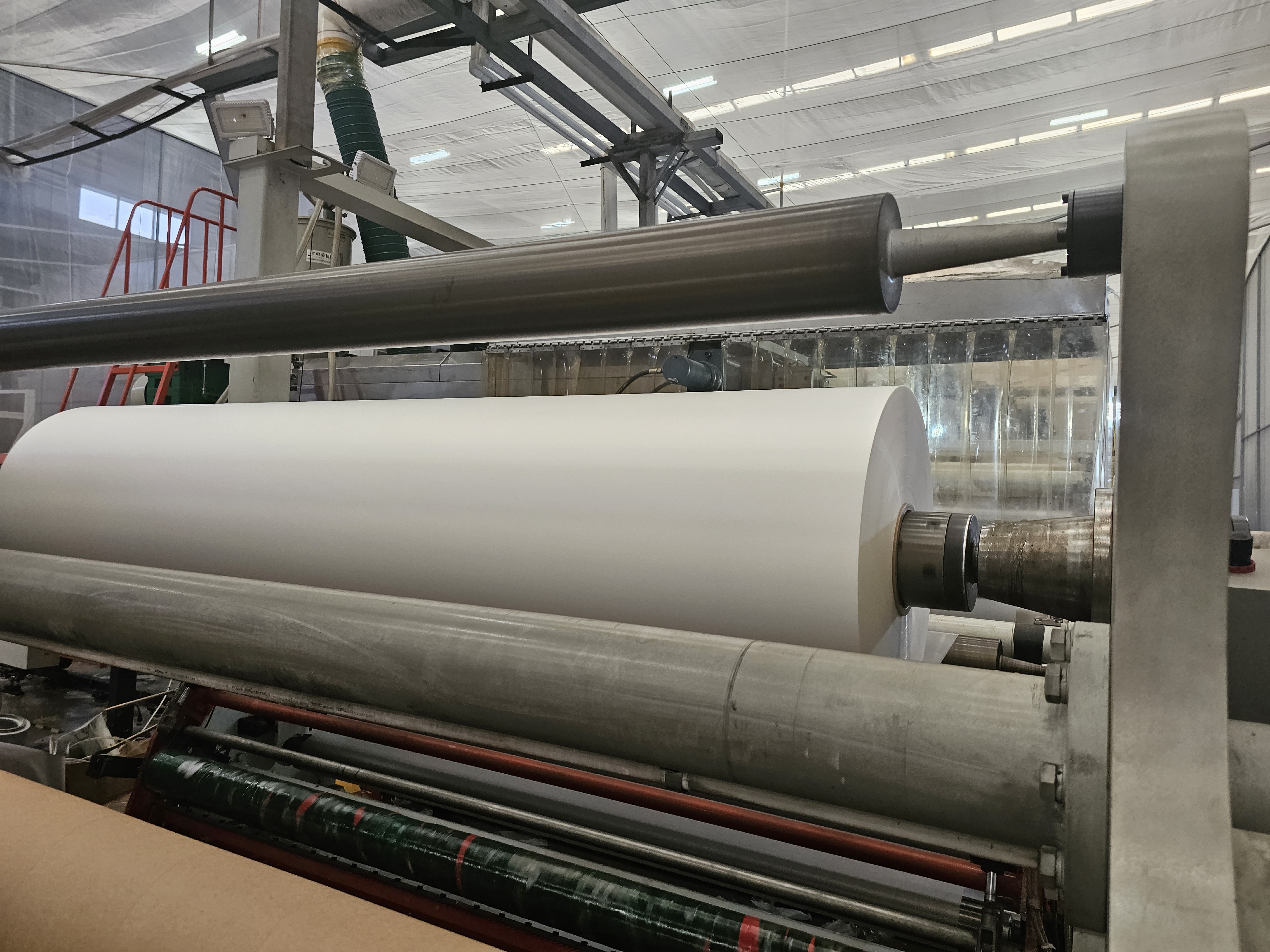
For book covers and standard folding cartons, the main compliance questions are usually product identity, lamination performance and destination-market documentation. BOPP Thermal Lamination Film 6615 is supplied as a gloss or matte thermal film with a thickness range of 17–27 microns, roll widths of 320–2,180 mm and roll lengths of 2,000–9,000 m. The application data describes high-volume book covers, standard folding cartons and printed leaflets, using dry lamination with heated rollers and no solvent odors or adhesive coating on-site. In this use case, ISO 9001 and AEO may support supplier qualification and export documentation, while food-contact certificates are only relevant if the printed pack enters a food-contact application.
Cosmetic and electronics paper box packaging
Cosmetic and electronics boxes often require a tactile or protective surface, which moves the specification toward BOPP Specialty Lamination Films 6623. The supplied series includes anti-scratch, soft-touch and 3-in-1 anti-scratch, soft-touch and anti-fingerprint films, with a functional top-coat of 3–4 microns and a thickness range of 18–29 microns. For electronics-related supply chains, RoHS verification may be requested; for EU markets, REACH SVHC screening is a common checkpoint; for buyers with halogen restrictions, EN 14582:2016 testing may be specified. The SGS VOC reports under GB 33372-2020 are relevant where the buyer’s programme controls VOC content or odor. Because these reports are listed for the specialty thermal films, the buyer should confirm that the exact anti-scratch or soft-touch grade is named.
Food-contact packaging and no-primer base film
Food-contact packaging requires the most careful scope matching. The BRCGS certificate in the supplied evidence covers production of BOPP film from PP resin for direct and indirect food contact, and the related-product data links it to BOPP Matte Film for Wet Lamination (6647) and No-primer BOPP Base Film (6544). If a converter is producing thermal lamination film for a food-contact pack, the buyer should confirm which film in the laminate is intended to contact food, what the converter’s own food-safety documentation covers, and whether the supplier’s BRCGS scope extends to the exact grade. The no-primer base film 6544 is described as an unprimed substrate for inline EVA extrusion coating without primers or drying ovens; that design can simplify the coating process, but the finished laminate still needs its own compliance review.
Comparison table: supplied compliance documents at a glance
The table below summarizes the documents in the supplied evidence. It is a scope map, not a legal opinion. The “what it helps verify” column is an editorial guide for buyer qualification.
| Document | Issuer | Number | Supplied scope | What it helps verify |
|---|---|---|---|---|
| BRCGS Global Standard for Packaging Materials, Issue 7 (October 2024) | SGS | CN19/10136 | Production (extrusion, stretching, rewinding and slitting) of BOPP film from PP resin for direct and indirect food contact | Retail and food-contact packaging scheme; confirm exact product scope |
| ISO 9001:2015 | Qingdao Wanhui Inspection and Certification Co., Ltd | 57626Q00025R201 | R&D and production of biaxially oriented polypropylene films, and processing of functional films | Quality management system at the audited site |
| ISO 14001:2015 | Qingdao Wanhui Inspection and Certification Co., Ltd | 57626E00021R101 | Environmental management activities at sites involved in R&D and production of BOPP films and functional film processing | Environmental management system |
| ISO 45001:2018 | Qingdao Wanhui Inspection and Certification Co., Ltd | 57626S00018R101 | Occupational health and safety management activities at sites involved in R&D and production of BOPP films and functional film processing | Occupational health and safety management system |
| Advanced Certified Enterprise (AEO) Certificate | Qingdao Customs of the People’s Republic of China | A4202580 | All import and export activities of Shunkai for manufactured plastic films and laminating materials | Customs and supply-chain credential; mutual recognition in EU, North America, UK, Singapore, South Korea, Japan and over 50 countries/regions |
| REACH SVHC Test Report (EC No 1907/2006) | SGS-CSTC Standards Technical Services Co., Ltd. | CANEC26006197603 | BOPP Specialty Lamination Films thermal type; Candidate List of 253 SVHCs | EU SVHC screening for the named specialty films |
| RoHS Directive (EU) 2015/863 Test Report | SGS-CSTC Standards Technical Services Co., Ltd. | CANEC26006197601 | BOPP Specialty Lamination Films thermal type; tested via IEC 62321 series | Restricted-substances verification for the named specialty films |
| Halogen Test Report (EN 14582:2016) | SGS-CSTC Standards Technical Services Co., Ltd. | CANEC26006197605 | BOPP Specialty Lamination Films thermal type | Halogen-free test verification for the named specialty films |
| SGS VOC Test Reports (GB 33372-2020) | SGS-CSTC Standards Technical Services Co., Ltd. | CANEC26006194201; CANEC26006194203 | Anti-scratch gloss and matt film; 3-in-1 anti-scratch, soft-touch and anti-fingerprint film | VOC-content verification for the named specialty films |
Two limits are visible in the table. First, the management-system and customs certificates are company- or site-level documents; they do not replace product test reports. Second, the product test reports are written for specific specialty film families. A buyer should ask for a grade-level declaration when the purchase order names a different product, even if it belongs to the same supplier.
Regional requirements: what changes between markets
Regional compliance is not a single ranking of “strict” and “less strict” markets. The applicable documents depend on the end use. For EU-bound packaging, REACH SVHC and RoHS are common checkpoints, and halogen-free testing may be requested where the buyer’s programme restricts halogens. For US food-contact applications, FDA 21 CFR 177.1520 is a relevant regulation, and BRCGS is often requested in US and UK retail and food-service supply chains. For China, GB 33372-2020 VOC reports and GB 4806.15-2024 for food-contact adhesives are relevant to the supplied evidence and market context.
For Brazil, South Korea, India, Iran and Japan, the supplied evidence shows commercial supply of product 6544 over more than 10 years and more than 10,000 tons, and distribution of product 6615 in Brazil and Italy. That is useful supplier due diligence: it indicates experience with export documentation, different customer types and multi-region logistics. It is not a statement that every product is approved for every local food-contact or labeling requirement. A buyer should map the destination market’s rules to the exact film and end use, and ask the supplier for the specific declaration that supports the claim.
Limitations and acceptance criteria
Compliance documents have boundaries. A certificate can expire. A test report can cover one product family but not another. A scope can name a production activity but not a finished application. A supplier can hold a management-system certificate without holding a product-specific food-contact report. These are not reasons to reject a supplier; they are reasons to ask better questions.
A practical acceptance criterion is to require a grade-level statement for every product on the purchase order. The statement should name the product series, the standard, the issuer, the certificate or report number, the issue and expiry dates, and the intended market. Where a report is family-level rather than grade-level, the supplier should say so explicitly. Where a certificate is company-level, the buyer should keep it in the supplier-qualification file rather than the product-release file. This approach is more reliable than counting logos on a brochure.
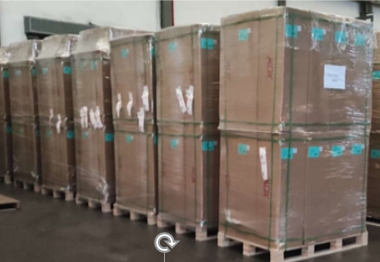
Next step for buyers: request the certificate matrix for the exact BOPP thermal lamination film grade, confirm the destination-market scope, and evaluate a sample on your lamination line. SHKFILM supports sample evaluation, technical application support and OEM/private-label supply; the SHKFILM brochure provides the product and company overview.
FAQ
How should buyers evaluate anti-scratch BOPP thermal lamination film manufacturers for compliance?
Start with the exact product family. For an anti-scratch specification, ask for the test package that names the Anti-Scratch Film Series / Soft Touch Film Series (product 6623), not a generic thermal-film certificate. In the supplied evidence, the specialty thermal films are covered by RoHS certificate No. CANEC26006197601, REACH SVHC certificate No. CANEC26006197603, Halogen-Free test report No. CANEC26006197605 under EN 14582:2016, and SGS VOC reports No. CANEC26006194201 and No. CANEC26006194203 under GB 33372-2020. Also check the company-level ISO 9001 certificate No. 57626Q00025R201 and AEO certificate No. A4202580, but keep them separate from product compliance. The decisive check is whether the report scope names the anti-scratch grade and whether the certificate is valid for the destination market. A sample trial on the buyer’s laminator remains the final performance check.
Conclusion
BOPP thermal lamination film compliance is a mapping exercise. The buyer must map the exact film grade to the certificate scope, the standard to the end use, and the document to the destination market. Management-system certificates, AEO status, BRCGS certification and product test reports each answer a different question. The supplied SHKFILM evidence shows a multi-region supply base: No-primer BOPP Base Film 6544 has been supplied for over 10 years and more than 10,000 tons across Brazil, South Korea, India, Iran and Japan, while BOPP Thermal Lamination Film 6615 has been distributed in Brazil and Italy. Those facts support supplier due diligence, but the buyer still needs grade-level compliance evidence for the specific application.
Use the four-layer evidence chain, the certificate matrix and the qualification workflow in this guide to make the supplier conversation more precise. Then confirm the final choice with a sample trial and a purchase specification that names the required documents. For product and company details, see SHKFILM and the SHKFILM brochure.
Have Questions or Need More Details?
Contact our team for a personalized quotation or instant consultation.
Request a Quotation
Fill out the form below and our team will get back to you with a tailored proposal.
WhatsApp Direct Chat
Prefer to chat in real-time? Message us on WhatsApp for instant assistance & quick answers.
- Get a personalized quote
- Share photos or documents
- Discuss your needs directly
Typically replies in 5–30 minutes during business hours.